About University
About University
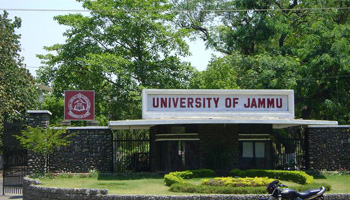
Cradled in the lap of mountains at the foothills of auspicious Trikuta, besides the river Tawi at an altitude of 1030 ft. is Jammu. This 'city of temples' has many places...
Cradled in the lap of mountains at the foothills of auspicious Trikuta, besides the river Tawi at an altitude of 1030 ft. is Jammu. This 'city of temples' has many places...


One of the emerging challenges faced by any higher educational institution is the development, application and maintenance of quality...
JU organizes International Conference on 'POJK-An Integral Part of India As a Geo-strategic Pivot in South Asia '
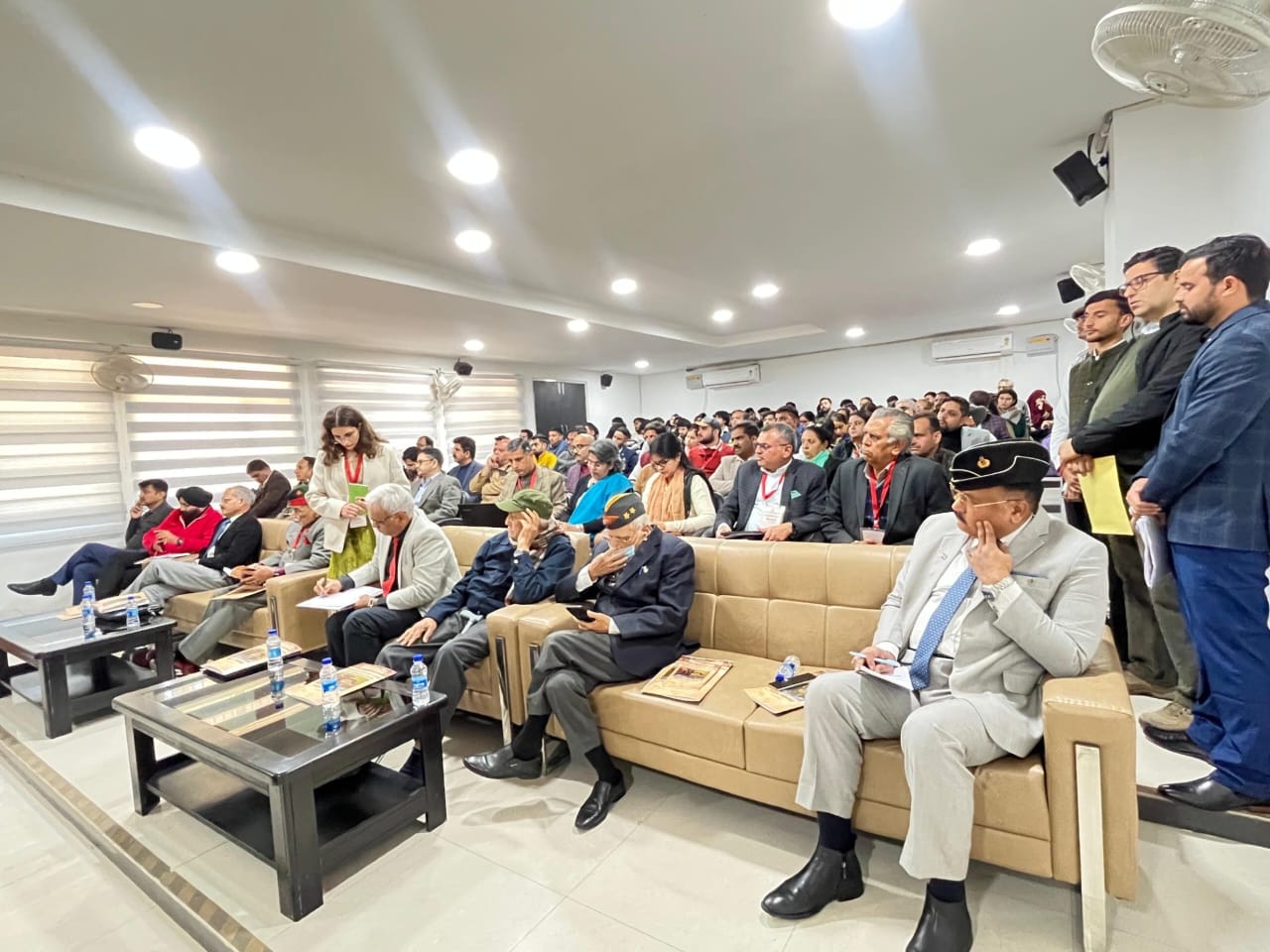
Jammu December 10: The Department of Strategic and Regional Studies (DSRS), University of Jammu today hosted an International Conference on “POJK – An Integral Part of India as a Geo-strategic Pivot in South Asia,” bringing together distinguished scholars, defence veterans, policy practitioners and students to deliberate on the strategic, political and historical dimensions of Pakistan-Occupied Jammu & Kashmir (POJK) and Ladakh.
The conference offered a comprehensive platform for critical analysis, policy introspection, and academic engagement on one of the most significant geopolitical concerns in India’s national security landscape.
The conference started by lightening of the lamp and paying tribute to the Bharat Mata by the Chief Guest, Prof. Neelu Rohmetra, Dean Research Studies, University of Jammu, Shri Ashutosh Bhatnagar, President of JKSC, Colonel (Retd.) Ajay Raina, Prof. Virender Koundal, Director DSRS, and other dignitaries.
Prof. Neelu Rohmetra, Dean Research Studies, University of Jammu, presided over the conference as the Chief Guest and delivered impactful presiding remarks.
She underlined the role of academic institutions in shaping informed national narratives, encouraging evidence-based research, and nurturing a sense of belongingness towards the occupied territories. She emphasised that for India to pursue a coherent national strategy, research scholars must approach POJK with intellectual sensitivity and a deep emotional connection.
Prof Rohmetra called upon scholars to undertake rigorous research on the historical, legal, sociocultural and strategic aspects of POJK, ensuring that India’s academic output supports policymakers with credible and comprehensive insights. She said that research on POJK must be infused not only with academic rigour but also with national responsibility, as the region holds significant implications for India’s identity, unity and long-term strategic standing.
In his keynote address, Col. Ajay Raina (Retd.) gave a detailed and candid overview of the historical events that shaped the status of POJK.
Col. Raina stressed that the territories under Pakistan’s illegal occupation remain central not only to India’s territorial integrity but also to the changing geostrategic landscape of South Asia. He said that a number of strategic and geopolitical opportunities were lost over the years as a result of preventable errors. This included a lack of persistent political will to take back the parts of POJK and Ladakh under foreign occupation, inconsistent diplomatic engagement, and a failure to internationalize Pakistan’s violations, he added.
Col. Raina went into detail about how these mistakes damaged India’s negotiating position abroad and led to a skewed perception of Jammu and Kashmir around the world. He referred to the region’s strategic and economic potential and said POJK is an important connection to Central Asia, a resource-rich and strategically significant region. He called for a renewed national commitment to correcting past mistakes and creating a forward-looking plan based on diplomatic clarity, military readiness, and political consensus.
Guest of Honour, Shri Ashutosh Bhatnagar provided an insightful perspective on the necessity of “course correction” in national policy. He highlighted that reclaiming POJK is not merely a cartographic issue but a humanitarian and civilizational one.
Sh. Bhatnagar stressed the importance of reconnecting with the people of the occupied regions—many of whom continue to face political repression, demographic changes, and human rights challenges. He emphasized that in order to ensure that the people of POJK and Ladakh continue to be a part of India’s collective consciousness, India must restore its cultural, familial, linguistic, and historical ties with them. He contended that scholarly endeavors, interpersonal interactions, cultural outreach, and unified policy messaging are necessary to fortify this relationship.
Shri Bhatnagar called on think tanks, academic institutions, and civil society organizations to broaden their research and outreach in order to bring the experiences, hardships, and goals of people in POJK into the mainstream Indian discourse. He stressed on India’s futuristic policies on POJK’s and PoJK’s future with India by creating research projects that help the government make well-informed decisions and policies.
Earlier, Prof. Virender Koundal, formally welcomed the dignitaries and introduced the theme of the conference.
After the inaugural session, another major session was chaired by Shri Ashutosh Bhatnagar.
In this session, four POJK researchers and activists living in exile and POJK made Online presentations.
Mr. Senge Hasnain Sering of Institute for Gilgit-Baltistan Studies joined online from USA, Dr Amjad Ayub Mirza from UK, Mr Surinder Zutshi from USA, and Mr. Tanveer Ahmed joined online from Muzaffarabad and all spoke on Pakistan’s mechanized exploitation of POJK and why POJK must get support from India for their genuine issues.
Thereupon, Mr. Pradeep Dutta of NDTV spoke on how Pakistan has made POJK a theatre for Jihad in J&K.
Brig. (Retd.) Brijeh Pandey spoke on POJK from the context of China-Pakistan Economic Corridor.
The session concluded with the presentation by Dr. Ajay Sharma, who spoke on the inclusion and exclusion of displaced persons of Pakistan Occupied Jammu and Kashmir.
The One-Day conference featured participation from faculty members, defence experts, research scholars, students, and practitioners from various institutions of India as well as Online presentations from researchers and activists of POJK living in exile.
The discussions explored themes such as the historical evolution of the territorial dispute, the strategic importance of POJK in the context of emerging regional dynamics, China-Pakistan strategic convergence, humanitarian issues in occupied territories, and India’s future roadmap. Participants underscored that POJK, with its rich cultural heritage and strategic location is inseparable from India’s civilizational and geopolitical framework.
The conference concluded with a renewed academic commitment to intensify research on the subject, promote awareness, and ensure that the discourse on POJK remains grounded in facts, national aspirations, and future security considerations.
The conference concluded with valedictory session presided by the Chief Guest, Prof. J.P. Singh Joorel, Dean Academic Affairs, University of Jammu.
The Keynote address of this session was delivered by Brig. (Retd.) Pankaj Chib, SM, VSM.
Prof. J.P. Singh Joorel, presented concluding remarks on the international conference.
Both the inaugural and valedictory sessions of the conference were anchored by Dr. Mohd. Monir Alam and the Vote of Thanks was delivered by Dr. Surinder Mohan.
The conference was graced by Maj. Gen. Goverdhan Singh Jamwal, Col. Virendra Sahai, Padamashree Prof. K.N. Pandita, Prof. Satinder Kumar, Prof. Suman Jamwal, Prof. Prakash Anthal, Prof. Dipankar Sengupta, Prof. Vinay Chauhan, Prof. Anil Gupta, Prof. Jeevan Jyoti, Prof. Tarsem Lal, Dr. Ganesh Malhotra, Dr. Ranjan Sharma, Dr. Sunil Sharma, many other eminent academicians, journalists, member of the civil society and students have attended and participated in the conference.