About University
About University
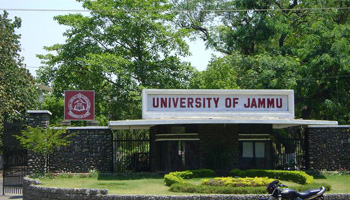
Cradled in the lap of mountains at the foothills of auspicious Trikuta, besides the river Tawi at an altitude of 1030 ft. is Jammu. This 'city of temples' has many places...

Cradled in the lap of mountains at the foothills of auspicious Trikuta, besides the river Tawi at an altitude of 1030 ft. is Jammu. This 'city of temples' has many places...



One of the emerging challenges faced by any higher educational institution is the development, application and maintenance of quality...
Retention of Tibetan Buddhist Culture in Exile: An Inspiring Example for Global
Endangered Cultures
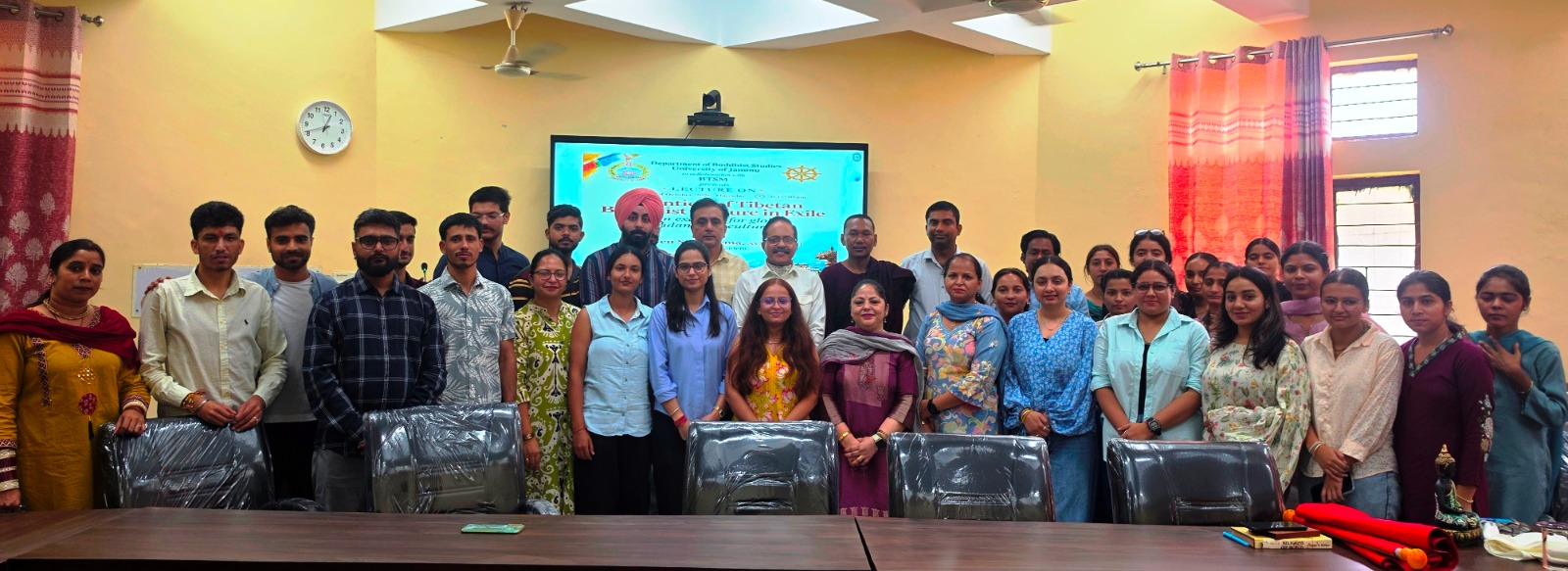
Jammu: The Department of Buddhist Studies, University of Jammu, in collaboration with the
Bharat Tibet Sahyog Manch (BTSM), organised a guest lecture on “Retention of Tibetan
Buddhist Culture in Exile: An Inspiring Example for Global Endangered Cultures.” The
lecture focused on the remarkable resilience of the Tibetan community in preserving its religious,
cultural, linguistic and philosophical heritage despite displacement and prolonged separation
from its homeland. The programme commenced with Buddha Vandana, presented by
Venerable Vicitassara, Ph.D. Research Scholar from Myanmar, along with students of the
Department of Buddhist Studies. Dr. Rajesh Sharma, In-charge Head, Department of
Buddhist Studies, delivered the welcome address. Mr. Aruna Tharanga, Ph.D. Research
Scholar from Sri Lanka, introduced the guest speaker and presented his biographical profile.
Retired Major General Shiv Kumar Sharma, National President, BTSM, delivered
the guest lecture. He described the preservation of Tibetan Buddhist culture in exile as a
significant example of cultural resilience in the contemporary world. He observed that Tibetan
culture is deeply rooted in Buddhist philosophy and encompasses a rich heritage of language,
literature, monastic education, philosophy, meditation, rituals, traditional knowledge, art,
architecture and community practices. Major General Sharma emphasised that displacement,
migration and geographical separation from one's homeland can pose serious challenges to the
continuity of cultural traditions. However, he noted that the Tibetan community has
demonstrated remarkable determination in preserving its cultural identity through sustained
efforts in education, religious institutions, community participation and the intergenerational
transmission of knowledge. He particularly highlighted the role of Tibetan monasteries,
educational institutions, cultural organisations and scholars in ensuring the continuity of
Tibetan Buddhist traditions. The transmission of Buddhist philosophy, spiritual practices,
language and traditional knowledge to younger generations, he said, has enabled the community
to safeguard its cultural identity while responding to changing social and global circumstances.
The speaker further observed that the Tibetan experience has significance beyond the Tibetan
community. Many indigenous and traditional cultures across the world are facing challenges
arising from globalisation, migration, modernisation, language loss and rapid technological
change. In this context, he stated, the Tibetan experience offers valuable lessons for
communities seeking to preserve endangered languages, cultural traditions and traditional
knowledge systems.
He stressed that education, community participation, institutional support and
international cooperation are essential for safeguarding endangered cultures. Cultural
preservation, he emphasised, is not merely about protecting the past; it is about ensuring that
traditional knowledge, values, languages and practices remain meaningful, relevant and
accessible to future generations. The lecture concluded with a renewed emphasis on the
importance of preserving Tibetan Buddhist heritage and cultural diversity as an invaluable
resource for humanity. It was also emphasised that the Tibetan experience provides an
important lesson for the preservation of the rich cultural traditions, language, heritage and
identity of the Dogra community, and that concerted efforts are needed to transmit this heritage
to future generations.
The vote of thanks was proposed by Dr. Vivek Sharma, who expressed gratitude to the
guest speaker for his valuable insights and appreciated the collaborative efforts of the
Department of Buddhist Studies and BTSM in organising the programme. The proceedings were
conducted by Ms. Ginni Sharma and Ms. Ruchika Sharma, Ph.D. Research Scholars. Among
those present were Dr. Padam Singh and Dr. Sandeep Dubey from the Department of Dogri,
Dr. Ekta Kumari, Dr. Neeru Chaudhary, members of the office staff, research scholars and
students of the Department of Buddhist Studies.