About University
About University
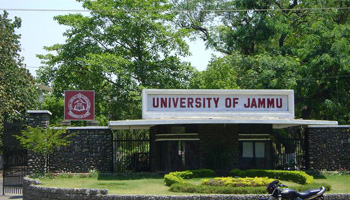
Cradled in the lap of mountains at the foothills of auspicious Trikuta, besides the river Tawi at an altitude of 1030 ft. is Jammu. This 'city of temples' has many places...
Cradled in the lap of mountains at the foothills of auspicious Trikuta, besides the river Tawi at an altitude of 1030 ft. is Jammu. This 'city of temples' has many places...


One of the emerging challenges faced by any higher educational institution is the development, application and maintenance of quality...
University of Jammu Organised a Panel Discussion on “Iran–Israel–US Conflict: A Catalyst for New Energy Shock”
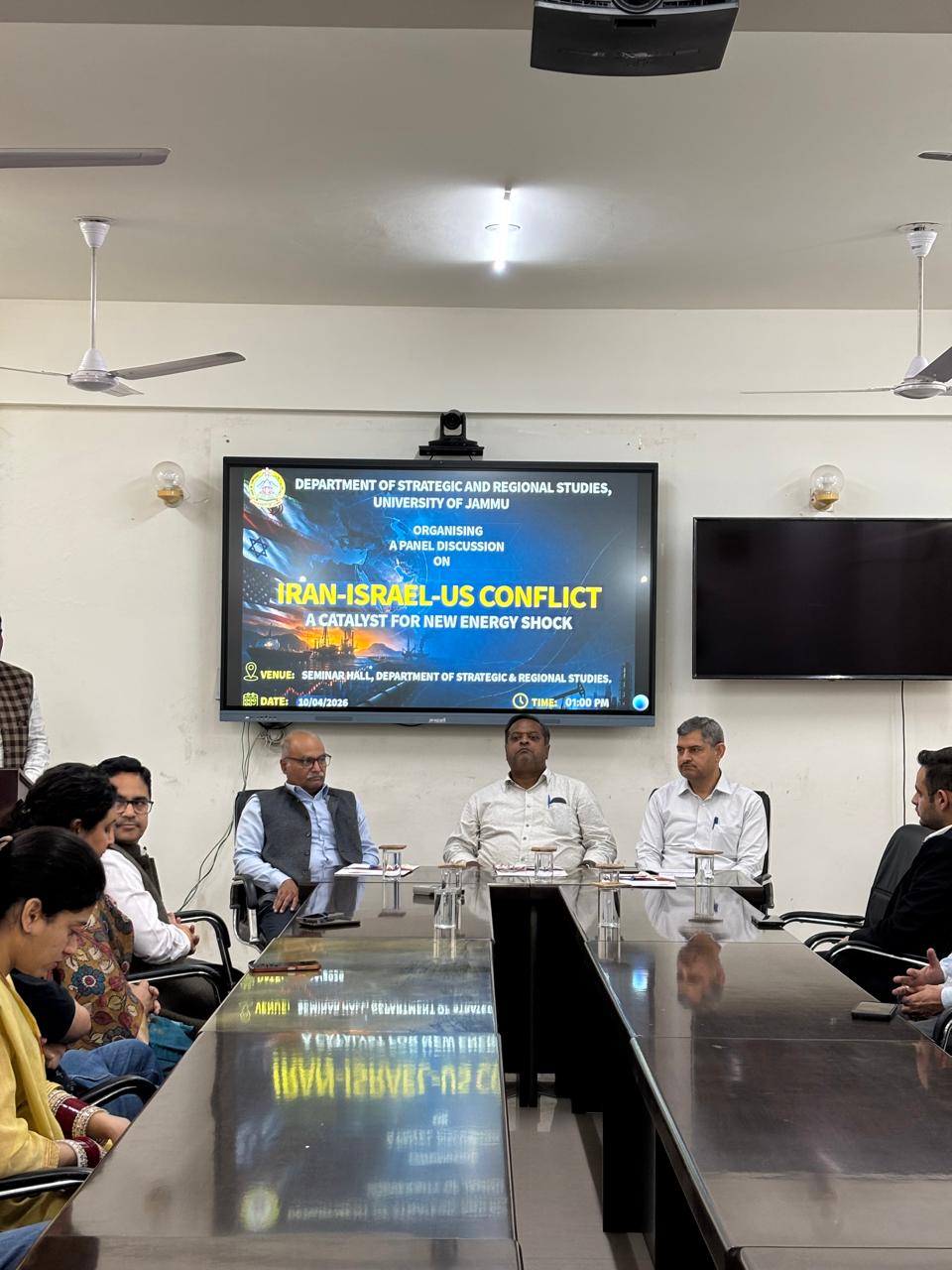
Jammu, April 10: The Department of Strategic and Regional Studies, University of Jammu, successfully organised a panel discussion on the theme “Iran–Israel–US Conflict: A Catalyst for New Energy Shock.” The event brought together eminent scholars and practitioners to deliberate on the evolving geopolitical tensions in West Asia and their far-reaching implications for global energy security and international stability.
The panel featured distinguished speakers including Prof. Rajesh Kumar from the Department of Political Science, Guru Nanak Dev University, Amritsar, Punjab and Sh. Nagendra Singh Jamwal, JKAS, Special Secretary in the Office of the Chief Secretary, Union Territory of Jammu & Kashmir. The session was moderated by Prof. Dipankar Sengupta from the Department of Economics, University of Jammu.
The programme commenced with a ceremonial lighting of the lamp and warm welcome address by Dr. Mohd Monir Alam, who greeted the distinguished speakers and participants. In his remarks, he highlighted the relevance of the theme in the contemporary global context and underscored the importance of academic dialogue in unpacking complex geopolitical and economic challenges.
Prof. Rajesh Kumar, in his address, presented a detailed geopolitical analysis of the Iran–Israel–US conflict, tracing its historical evolution and examining the complex strategic dynamics shaping the region. He highlighted the shifting balance of power and underscored the risks of further escalation, noting its potential to significantly influence global political alignments. Additionally, he drew attention to the legal dimensions surrounding the conflict, emphasizing issues of international law and state responsibility. Prof. Kumar strongly advocated for constructive dialogue and peaceful engagement among the concerned parties as the most viable path toward sustainable conflict resolution.
Sh. Nagendra Singh Jamwal provided a comprehensive perspective on the policy and administrative dimensions of the ongoing conflict, highlighting its significant implications for India’s energy security and broader strategic interests. He emphasized the urgent need for flexible and adaptive policy frameworks to effectively respond to uncertainties arising from global energy disruptions. He also critically pointed to the limitations and ineffectiveness of the United Nations in managing and resolving such conflicts. Furthermore, he cautioned that any potential closure of the Strait of Hormuz would severely impact India’s hydrocarbon-dependent industries, potentially triggering supply shortages, rising inflation and increased unemployment, thereby posing serious challenges to the country’s economic stability.
Moderating the discussion, Prof. Dipankar Sengupta steered the conversation towards the economic consequences of the conflict, particularly focusing on volatility in oil prices, supply chain disruptions, and the prospects of a new global energy shock. He underscored the importance of diversifying energy sources, strengthening strategic petroleum reserves and accelerating the transition towards renewable energy as long-term mitigation strategies. Through his insightful moderation, he facilitated a dynamic and engaging dialogue, encouraging participants to critically examine the intersection of geopolitics and energy economics.
The panel discussion served as a timely and insightful platform to understand the complex interplay between geopolitics and energy economics in the context of contemporary global conflicts. The proceedings of the programme were conducted by Ms. Kanika Chib, M.A. 2nd Semester student of DSRS. The Vote of Thanks was delivered by Dr. Ganesh Malhotra. The programme was attended by Prof. Virender Koundal, Director, DSRS; Dr. Surinder Mohan, Dr. Ranjan Sharma, Dr. Sunil Kumar, research scholars and students from the Department of Strategic and Regional Studies, as well as other departments of the University.